Category Archives: Thinking & writing

First drafts nearly always need to be improved

‘Developing documentation, especially user-centred documentation, is not a one shot process. It is a continual process of successive refinement.’  (William Horton)

Another way of saying this is ‘There is no such thing as good writing – only good rewriting.’

So, expecting to generate perfect text on your first draft is unrealistic.

When writing in plain language we are always aiming to write user-centred text, and so we will always be refining our structure, words and sentences as we get feedback from our users, as we test our documents with the people who need to use them to do something useful.

Genuine feedback from users, often through formal user testing, is often forgotten in plain language writing projects.

Make sure you include feedback beyond just internal review processes.

There is no need to include everything you have thought about when writing

When you are drafting a document, you will likely make some notes as you prepare. These notes both shape and reflect your thinking.

Your document will be designed for your reader, to shape their thinking and influence their response.

Never feel obliged to include all your thinking notes in your final document. You will usually have explored ideas that may be interesting, but perhaps not relevant, to your user. Including everything you have thought about will often result in a cluttered document that readers may get lost in.

Carefully selecting content, deciding what to include and what to leave out, is the key to crafting an effective document. Include only what is necessary to a) meet your readers’ needs, and b) achieve your purpose.

Writing to achieve an outcome – the organisation’s intent

When we are writing at work, the document we produce needs to achieve an outcome for our organisation.

Perhaps the outcome is people buying a product, workers acting in a specific way, staff well aligned to goals, or some other intent.

Documents we produce at work can be described as ‘functional documents’.

That is, we write them to help the organisation achieve a goal of some sort.

Having this goal clearly in mind as you craft your document gives you focus. It helps you decide what content you will include, how you will organise the ideas, and the words you will use to get these ideas into your readers heads in a way they will they will respond in they way you want.

But, of course, your document must also meet your users’ needs.

Keep both sets of needs in mind as you write – the needs of your organisation and the needs of your reader.

How to increase the chances of people reading your text

People are more likely to read your text if it answers a need they have

– if it gives them the knowledge they need to make a decision, or information they can act on to do something useful, or an insight that interests them or intrigues.

That’s why thinking about your reader – they are the user of the information product you will produce – thinking about your reader is so important before you start writing any document.

Think about their needs and interests, their fears, and the work they need to do. What do they want out of your document. Consider the questions they may have about the topic you are writing about.

But, if your document is going to be truly effective, it’s not just about your reader. The document must meet your organisation’s needs too.

How to write reports that people want to read

One of the most useful ways to think about a report, any report, is to consider a report as an answer to a question.

When someone asks you to write a report, they are seeking information about something they don’t know. So, your job when writing a report is to answer that question.

Having a clearly defined question at the beginning helps focus your work, helps to minimise unproductive investigations, and will make your report more useful.

But make sure you have the correct question – one that probes the heart of the matter.

Spend some time with the person who has commissioned the report and the likely readers to explore what they really need to know. Ask them what they will do with the answer you provide.

And of course, maintain your integrity. Never write a report to provide a predetermined answer.

Predicting your readers’ response can help guide your writing

Before you write your document, spend some time thinking about your reader.

Consider their passions and concerns, their situation and pressures, and the decisions they need to make or or the tasks they need to perform.

When you think from the readers perspective, you’ll be able to make a reasonable guess about how they will receive and react to your message.

That knowledge, even though it is a guess and is unsure knowledge, can inform the way you select content. It will help you decide what to include and what you’ll leave out. It will also guide how you organise your document. You can design a flow of argument that will resonate with your readers.

And you may be able to pre-empt questions and objections and address these before negativity become settled in your readers’ minds.

Social justice when writing

Clear, well-written documents from businesses and government agencies help people understand their rights, responsibilities, and options.

When information is written in plain language, more people can access, understand and act on it. This leads to fairer outcomes and greater participation. Complex, technical, or overly formal writing can exclude many readers — especially those who do not have an academic background or who struggle to read.

We can create or exacerbate social disadvantage just by the way we choose to word things and express ideas. That is a really sad outcome. Choosing not to write plainly can create disadvantage, limit access to essential services, and undermine trust.

Writing clearly isn’t just a communication skill — it’s a matter of equity.

Don’t assume others know all the words you do

If you have completed studies beyond high school, you likely have a broader vocabulary than most people.

You will likely know the meaning of more complex words and also be able to untangle complicated sentence structures. While this can be useful in academic or professional settings, it can work against you when you are writing for a broader audience. You may inadvertently assume your readers are OK with some words and phrases just because you are.

So, consider your audience when writing. Limit your use of uncommon or technical words, and stick to everyday language, the kind you’d find in a newspaper.

Simple, familiar words make your writing easier to understand for everyone.

Business and government documents must be written well because…

Business and government documents often contain important information that places obligations on individuals, such as legal responsibilities, financial commitments, or compliance requirements.

When these documents are not written clearly, there is a real risk that people may misunderstand or only partially understand what is required of them. This confusion can have serious consequences, such as missed deadlines, penalties, or unintended breaches of the law.

Poorly written documents can create unnecessary stress, disadvantage, or even oppress people—especially those with lower literacy levels, those for whom English is a second language, or those in vulnerable situations.

Clear and accessible writing helps everyone understand their rights and responsibilities. It promotes fairness, reduces errors and disputes, and builds trust in institutions.

Plain language is also about honesty

Writing plainly means choosing words and sentence structures your readers can easily read, understand and use – information that is designed with their needs in mind.

But plain language is about more than just simplicity — it’s also about honesty and clarity.

A plain language document must give readers accurate, complete, and useful information. That means being upfront, leaving nothing important out, and avoiding confusing or misleading wording. There is no room for half-truths, vagueness, deliberate ambiguity, or obscured meanings.

Readers should be able to trust what they’re reading and clearly understand what it means. Writing this way shows respect for your audience and helps them make informed decisions.

In all government and business communication, plain language supports transparency, accountability, and better outcomes for everyone.

Audit vs Evaluation

Audit vs Evaluation – what’s the difference?

Audit’ answers the question ‘Did we do what we said we would do?’ For example, did we publish the document?, did it go out on time?, did it reach all our clients?

Evaluation’ answers the question ‘Did we achieve the outcome?’ For example, do our clients now understand our services?, are our procedures efficient?, how well did we predict that development?

Both types of questions are clearly important and have a role in managing an organisation well. But often matters that should be evaluated are audited instead.

For example, suppose you recognise a communication need – you want your clients to better understand what you can do for them, or you want the public to take advantage of a new government policy or initiative. The usual course of events goes something like this:

  1. Decide you need a product (people usually think a document or website is the best way to deliver information)
  2. Set goals and assign responsibility to someone (their job is to deliver the product)
  3. Tell your boss and colleagues about the product
  4. Get a project team together
  5. Develop a project timeline and determine a budget.
  6. Get the resources you think you will need
  7. Develop the product
  8. Deliver

How is a project like this measured? Usually against the project plan.

If the product is on time and on budget it is usually considered a job well done.

But that’s audit, not evaluation. Only rarely is the project measured against purpose.

Where do things go wrong?

There are at least two points of disconnect in this scenario:

1. Deciding a particular product (brochure, white paper, website) will achieve the objective even before the team has had a chance to explore options. This product is then locked in with your boss and colleagues so that it is hard to work on a new idea even if it is better.

2. Shifting the goal from ‘communicating’ to ‘producing a product’. While it’s easier to measure product production it is not the right thing to measure.

The solution is simple, but not easy.

Suspend judgement about what needs to be produced until after you have explored the users’ needs, the content to be communicated and the purpose of the communication. Never lose sight of the overall goal. Always be prepared to consider a change to the product if you come upon a better idea. When dealing with particularly complex material it is usual to have some ideas that initially look very good, but that are later rejected. Going up a few dry gullies is not failure, it is the nature of exploration.

How to introduce a new idea

When introducing a new idea to people, remember, most people tend to stay loyal to their initial point of view. Moving to a new way of thinking takes some effort.

A single piece of paper, no matter how well written, may not be sufficient to sway an entrenched mind. Recognise that moving to a new way of thinking is rarely immediate – even when presented with compelling information.

Persuasion sometimes takes time and multiple presentations and encounters with new information in various forms.

So, when you write, aim to keep the lines of communication open so  your audience can understand and assimilate your message over time.

How to review documents: Be gentle and kind, but robust

If you are working inside an organisation, it is likely that everything you write will be reviewed by someone else before it is published or reaches its final destination.

Document reviews can be challenging for writers, so if you are a reviewer, please take care.

When reviewing someone’s work, remember what they have written is a reflection of their thinking and of themselves. That’s because thinking and writing are closely related.

Editing can be seen as criticising someone’s writing, and some people will take that as criticising their thinking. None of us like that. All writing is personal to some extent.

So, consider the person, not just the text.

But that is no reason to allow sloppy or ineffective writing to slip through. Be robust too so that whatever moves around inside the organisation, or that goes outside, is fit for purpose.

Purposeful communication – beyond shared understanding

In business and government, we write functional documents. Functional documents demand purposeful communication.

Traditional models of communication have understanding as the goal of communication. A person constructs an idea, codes into media (speech, text, images), and then transmits it. The receiver decodes and reconstructs that as a new idea. Feedback and re-transmitting continues until both the sender and the receiver have the same idea. That is, the aim is a shared understanding. But that is not good enough for functional documents.

Purposeful communication starts by asking ‘Why?”.

The purpose of all business and government communication is to impact the thinking, attitudes or behaviour of readers in some way. We write to achieve an organisational purpose.

For example, marketing communication aims, ultimately, to get people to buy from you. Policies and procedures aimed to cause people to act in a particular way.

Purposeful communication goes beyond understanding and effectively transmitting ideas. It is more about influence.

So, the simplest way of testing any communication piece is to look at your audience. Are they doing what you wanted them to do? Are they moving towards doing what you want? Is your document achieving purpose?

Define purpose before you write

Plain language writing starts by being clear about your purpose. Before writing, complete a sentence in this structure:

As a result of reading this document <my reader> will
<do, think, feel> something.

The purpose of your document will support the overall purpose of your organisation.

For a government agency or not-for-profit, purpose will likely be related to fulfilling its mission. That mission may be to provide good roads or to administer taxes fairly or to provide care services to a part of the community.

For a business, its ultimate purpose is probably to make a profit. (But there will be other important things like ensuring its employees work safely, protecting the environment and the like.) A business will have other aims and objectives that support this purpose like increasing market share, keeping quality on track, or improving the skills of its employees.

Effective purposeful communication will supports these aims and objectives.

Workplace communication aims to enhance the business performance of the organisation. Purposeful communication enables and energises employees to carry out strategic intent. Communication is a means, not an end.

Can you know a document will achieve purpose before it is published?

Sensible user testing gives good insights and can help you avoid reckless writing. Communication products, like all products, should be tested before being released.

Think in ink

Putting your thoughts on paper gives rigour to your thinking. Vague notions can no longer hide in the dark recesses of the mind, they must be brought into the light where they can be examined more closely.

Thinking is only valuable when it can be expressed

If your thinking just stays in your head, it’s not of much value to anyone – even to yourself.

Writing crystallises your thinking, even if it’s just a few words or half a sentence. It frees up short-term memory space – by holding your thoughts on paper rather than in your head – so creativity can flow once more. Mind maps are a great tool when exploring ideas. As you quickly jot down ideas and chunk them together new, related ideas quickly spring to mind.

If you are writing process instructions or specifications, more complete sentences will help make your thinking more precise. Writing forces deep and complete understanding that’s difficult to get by just thinking or talking.

thinking and writing are recursive activities

Something special happens when you force your thoughts onto paper. “Almost” ideas become more concrete, better understood and actionable.

‘The world can only be grasped by action, not by contemplation… The hand is the cutting edge of the mind.’ Jacob Bronowski

Action – start writing your thoughts

Struggling with a difficult issue? Start writing!

Paper, white board or the back of a bus ticket; single words or full sentences – it doesn’t matter. Just get your thoughts out there where you and others can examine and build on them.

How to write procedures for business benefit

Most businesses define work activities in a written procedure. (If your business doesn’t, it should.) Procedures, sometimes called Standard Operating Procedures, Work Instructions or Safe Work Method statements, are the basis for a well controlled business.

But how do you write a procedure well? What makes a good SOP?

You could mindlessly follow a template someone else has developed, or you could think about what you want to achieve, what would work best for your business. Some templates can be helpful, but they may not be best for your organisation. See some examples.

The elements of good work procedures

A purpose statement and a link to overall process

Workers need to know how the activity they perform fits into the big picture; how it contributes to the overall process and the purpose of the organisation.You could do this with a context statement, or locating the activity in a process map. Also give a thoughtful title to the procedure.

When working in the road surfacing industry, we changed a procedure title from ‘Drive the broom tractor’ to ‘Prepare the surface’. This had an immediate impact on how workers viewed the activity and lifted the self esteem of the broom driver.

Performance standards

Procedures should do more than merely provide a list of tasks to perform. They should include information about how to assess the quality of those tasks. Workers and supervisors then have some objective measures to judge performance.

The standards could be related to quality, performance or safety.

Grouped into sensible work chunks

Chunking work into steps and sub-steps provides helpful structure for workers. It avoids a long list of tasks, and fits well with the way workers think about the job.

For example, the work chunk ‘Find outstanding invoices’ could have sub-steps like Find the file, Search invoices by date range, Print report.

‘Thinking’ and ‘Doing’ sections

“Work is the exercise of discretion within boundaries.”
John Ralph, former CEO of CRA.

Procedures, SOPs, define the boundaries. They are the things workers must do. But to better engage workers, we want them thinking about their work too. That’s good for them and good for the business. So we might want to direct thinking about productivity, safety or environmental matters.

For example, include thinking prompts in the procedure like: ‘How could we reduce the paperwork?’ ‘Residents may be moving in and out of driveways as you inspect the footpath – take care.’

Standard resources

Include the equipment needed for the task, including safety related equipment. Describe the skills and competencies required. It may be appropriate to include the standard time taken for the task.

All this information allows you to cost the procedure and measure the impact of improvements and changes to business practice. For example, we discovered it takes 10 minutes to process and record payments into a law firm’s trust fund. If the firm offers clients a payment plan, increasing the number of payments, they may significantly increase their back office costs.

Plain language

All documents should be written in plain language.

When procedures are written plainly, workers can understand them quickly and implement them. If they are written in a style that workers find difficult, they may be confused and do the wrong thing, or waste time asking for clarification, or totally ignore the procedures and do what they think is best.


Think before you consult when writing policies

Employee consultation has become a ‘sacred cow’ when writing policies and procedures. There’s a tendency for organisations to involve all possible stakeholders so that everyone can have their say when defining how things work in an organisation. It’s promoted as a way to create an engaged and empowered workforce; an antidote to a command and control culture.

But consultation takes time and can be counter productive. Countless hours can be lost in document reviews and meetings, sometimes with little benefit.

Yet consultation communicates that you and your organisation value people and respect their point of view, knowledge and experience.

So, think before you run every policy through the same consultation process. Discern which documents will benefit from consultation, and who should be involved.

Consider policies in three broad groups:

1. Policies where consultation is pointless

If you are developing policies or procedure to implement a non-negotiable directive from the board, or a piece of legislation, consultation may not be helpful. Just write the document and get on with it. Consultation in this situation may even be harmful – it can raise the expectation of negotiation and input when there is none. You could lose credibility.

2. Policies where input from others is essential

Sometimes subject matter expertise resides in a number of people. You’ll need to consult to find out what is happening, or the best way of doing something. Find the right people and involve them in every stage of drafting and review. You’ll end up with a richer outcome by listening to appropriate stakeholders.

3. Policies where people just want to have their say

There are some policies in an organisation that stir the passions – like the ‘car policy’. People want to be heard but full consultation is not mission critical. When developing policies like this, I often invite comment but don’t run a full consultation process. Of course, if you invite comment you need to consider it – revise the policy or provide other feedback.

(this blog inspired by a conversation with Adam Leonard, General Manager Human Resources, Anglicare)

How to avoid writing dull text

Nothing makes a document duller than turning verbs (action words) into nouns (labels). So ‘inspect’ becomes ‘inspection’, ‘manage’ becomes ‘management’ and ‘use’ becomes ‘utilisation’ (my pet hate!).

Some people think words like these sound official and the sort of language that should be used in business documents. It’s just plain dull. If you replace action words with labels your writing will lose its vigour and power.

But worse than that, it hides meaning. For example, you can write ‘perform an inspection’ without clearly stating what is being inspected. But when you write ‘inspect the …..’ you are forced to say what to inspect, and perhaps what you are looking for.

In general, using verbs forces greater rigour in thinking and greater precision in writing.

And always choose the simplest word you can find in preference to impressive,  pompous words.

How good writing drives good thinking (with a down-side)

There is a very close relationship between writing well and thinking well.
You cannot write well until you think well.

Writing helps thinking

The relationship with thinking is what excites me about writing.

When we write (and this could be a few words or even a diagram) we take the fuzzy, unformed ideas sitting in the back of our heads and make them explicit. We put them on a page or a screen. When we see our thoughts on paper, we are better able to interact with ideas, and thinking becomes richer and clearer.

The think-write-think process helps us figure out the best way of explaining ideas to others – we talk to ourselves and other people with greater clarity.

Poor writing is often the result of poor thinking. Ideas may be there, but if they haven’t been worked over and refined by writing and re-writing, they are unlikely to be understood by people other than the writer.

The down-side

The close relationship between writing and thinking means that every time you write something, you are exposing your thinking. That may be an uncomfortable thought. People may make judgements about your thinking capability based on the text you generate.

It’s all the more reason to strive to write plainly and clearly, so that readers can see through your words to interact with your ideas.

As with all endeavours, we can lift writing performance with proper training and disciplined practice.

Poor superannuation PDS readability disadvantaging workers

The superannuation industry is in the news again today; described as an “unlucky lottery”. Among other issues, poor information is still a problem – ” They’re bamboozled by poor disclosure …”

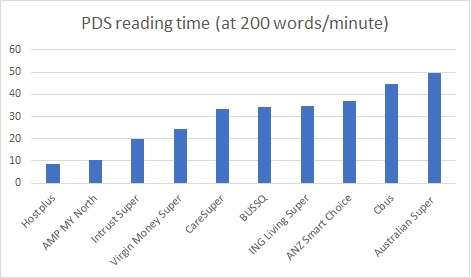
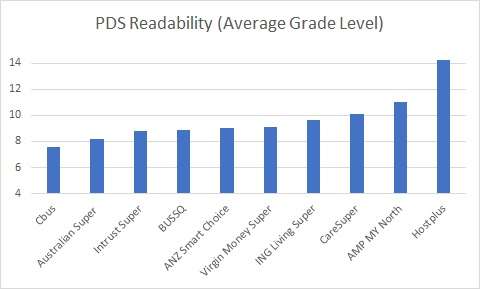
I thought I’d have a look at how easy it is to read some Product Disclosure Documents. I’ve looked at two dimensions across 10 popular superannuation funds.

1. Reading time

People are less likely to read longer documents. We all prefer to read short documents than long ones – we want information fast.

2. Readability

People need easy to read text to help them understand complex ideas. Readability indices are one way to measure how easy it is to read and understand text.

All these indices are higher than the Australian Government’s recommendation of about grade 7 – or maybe a little higher for this type of content.

Why readability matters

The PDS is a functional document. People are supposed to use these to decide whether the fund is a right fit for them. Of course they need to read and understand the information in the PDS to be able to make this decision. And this is an important decision that can have impacts over a lifetime.

Many application forms ask potential members to declare that they have read and understood the PDS. A lengthy or difficult to read document discourages reading. It may encourage people to make a false declaration – to tick the box without reading or understanding.

And difficult to read documents are risky for funds too. The focus is shifting from ‘did you read the document’ (aimed at the reader) to ‘is the document readable’ (aimed at the writer).

Be careful with readability tools

The readability tests I’ve used are mechanical tests that look at word and sentence complexity. They cannot be relied on by themselves, but a high grade index does indicate the text could be simpler. (The grade number refers to US school grade)

These tools do not consider document structure, meaning and the usefulness of content. It is possible to write highly readable rubbish.

The tests in detail

Reading time

I divided the total word count by 200. The average reader reads at about 200 – 220 words per minute.

Readability

I used computerised versions of

  • Flesch Kincaid Grade Level
  • Gunning Fog Score
  • Coleman Liau Index
  • SMOG Index
  • Automated Readability
  • Index Spache Readability Score
  • Dale-Chall Readability Score

and calculated the arithmetic mean.

Documents were sourced on 29 May 2018 from:

Hostplushttps://hostplus.com.au/financial-services-guide
Australian Superhttps://www.australiansuper.com/tools-and-advice/learn/product-disclosure-statements
Intrust Superhttp://www.intrustsuper.com.au/wp-content/uploads/Core-PDS.pdf
CareSuperhttps://www.caresuper.com.au/super/forms-publications/pds
Cbushttps://www.cbussuper.com.au/content/dam/cbus/files/forms-publications/general-information/Cbus-Industry-Super-PDS.pdf
BUSSQhttps://www.bussq.com.au/disclosure
ANZ Smart Choicehttps://www.wealth.anz.com/content/dam/anzwealth/pdfs/superannuation/Smart-Choice-Super-Pension-PDS.pdf
Virgin Money Superhttps://virginmoney.com.au/content/dam/virginmoney/vma-downloads/superannuation/Virgin-Money-Super-Product-Disclosure-Statement.pdf
AMP MY Northhttps://www.amp.com.au/content/dam/product/mynorth/MyNorth_SuperPension_PDS.pdf
ING Living Superhttps://www.ing.com.au/pdf/ING_DIRECT_Living_Super_PDS.pdf

Why people don’t read everything you write

Business readers are predictable. They usually read for information, not for pleasure. They are constantly under pressure from other demands that compete for their time.

The thoughtful writer tries to convey as much information as possible, accurately and as clearly as possible, in as little reading as possible.

Business reading is different to reading a novel. Don’t try to hold your readers in suspense. Get to the point fast. Often a reliable headline is all readers need. Readers are eager to put your document aside as soon as they decide they have all they need.

But the reader may put your document aside too soon. They may scan a report or memo quickly and decide “this doesn’t have anything for me”, and miss the most important point. Or the reader may find some good information, be pleased, then say (again wrongly) “OK good stuff. I don’t need the rest” and miss something even more important. The skillful writer needs to ensure that really important information is received properly.

What is the one statement about which a writer would be willing to say: “It’s all right if my readers read nothing else”. That should appear at the beginning. And if it does, it may be truly all right if the reader reads nothing else.

In wanting to stop early, the reader is not lazy or irresponsible; it is simply that the reader is reading only for information, is busy, and is eager to receive important information quickly, then move on.

In business and government writing, seek to maximise meaning, minimise reading.

Action

Next time you write, identify the one statement your readers must read to get your message. Put this near the beginning.

Some of these ideas have been adapted from Put it in writing by A Joseph.

When a logical structure doesn’t work

Sometimes structuring your document in what seems to be a logical order just doesn’t work.

We all know that the traditional “scientific” report structure we learnt in school is usually not the best way to present information to an audience. Its biggest problem is that it leaves the conclusion to the end – your readers have to trawl through pages of consideration and argument before finding out what you really have to say.

So normally we’d recommend you structure a complex document by putting the big idea first. You’d then gradually start to unpack that idea by providing more detail and examples. This helps your readers by giving them a framework to understand the detail. It also gives them the option of putting aside your document when they have read enough without missing out on your most important point.

But sometimes the ‘point first’ approach is not the best way. If your readers have a particularly burning question that they are expecting you to answer, you will engage them best if you satisfy them quickly. Even if their question is at a lower level of detail than the big picture you really want to talk about, answering their question early will save them the frustration of reading material that they think is irrelevant to them. However, be sure that you present the answer in context so that they are not misled.

So how do you decide what structure to use?

You must know your readers very well and know as much as possible about the things that are important to them. You also must know clearly why you are writing – what your purpose is. Are you trying to inform, persuade or entertain?

Action

Think

  • what are you trying to achieve?
  • what does your audience already know?

Structure your document to engage your readers’ interests and move them towards your purpose.

Writing is easy!

Writing is easy. All you do is stare at a blank sheet of paper until drops of blood form on your head. (Gene Fowler)

Nearly everybody finds it hard to write at some time. Next time that happens to you, try this 5 step process.

1. Plan

Write down the answers to these questions. Don’t just think about these questions – writing brings clarity.

Who is your audience? – characteristics, attitudes? What is important to them?

What do you want them to do? Do you want them to understand something or do something?

What information do they need? What do they need to know? When?

2. Capture ideas

Gather all the bits and pieces that you think may need to go into the document. You could use mind mapping or just start writing randomly.

Don’t worry about word choice, grammar or spelling.

Don’t worry about sequence

Don’t try to work out details

Use diagrams, shapes or symbols – not just words

Don’t be neat

3. Organise and shape

There are no hard and fast rules about organising. You cannot organise until you know what it is that needs putting in order. So be wary of templates – they can be useful, but they may also restrict your thinking.

Answering these questions will help you organise your document.

How will the reader discover this information?

Will they be looking for an answer to a specific question they have, or just reading for interest?

What are they likely to be doing when they encounter this information?

What will the reader do with the information?

Do they need to follow a procedure you are describing?

Do they need to combine this information with other information? Where will they get this from?

How can this be organised in a way that makes sense to my reader?

How are the ideas related? (usually, it is best to start with the ‘big picture’ before moving into detail)

What do my readers already know about this topic?

How can I organise this into less than 7 ‘chunks’? (Use headings to separate the chunks, use paragraphs to further organise the chunks.)

What can I safely leave out? (Readers find it tiresome to wade through text that has no relevance to their interest or needs.)

4. Write, edit and revise

There is no such thing as good writing, only good re-writing!

  • Get straight to the point.
  • Use words familiar to your reader.
  • Keep sentences short and simple. Each sentence should cover only one point.
  • Use the active voice and avoid the passive voice.
  • Write directly to your audience i.e. use ‘we’ and ‘you’.
  • Use verbs (action words), not nouns made from verbs.
  • Use simple, short words.

5. Test

Readers are the only people who can tell you whether your writing is good or bad. If possible, test your document on a sample of your target audience. Ask them questions to see if you have effectively conveyed your message.


Write for impact

The purpose of all government and business communication is to impact the attitudes, thinking or behaviour of readers.

For example, marketing communication is aimed at getting people to buy from you. Policies and procedures are aimed at causing people to act in a particular way.

So, before you write ask ‘Why?”. Why are you writing? What do you want the user to do as a result of reading your work? Be sure you know the impact you want to have before you put pen to paper, finger to keyboard.

Your purpose will depend on your organisation. In a business, your prime purpose is to make a profit. But other things are important too, like keeping workers safe, protecting the environment, etc. In government, purpose will be more likely related to mission – providing good roads, administering taxes fairly, or delivering care services.

Communication must be related to an organisation’s purpose – it goes beyond understanding and effectively transmitting ideas. It’s all about influence.

So, the simplest way to evaluate any communication piece is to look at your audience. Are they doing what you wanted them to do? Are they thinking in the way you want them to think? Did you have the impact you intended?

Action
Write down the impact you want to have before you start writing.

And before you publish, test your communication – will it have the impact you intend?

Good design gives information meaning

We have more information available now than ever before. Getting information is not the problem – making sense of it is!

Sifting and sorting – the key to meaning

People make meaning by sifting through information to find those bits that are important to them. They then sort it by placing like with like within their own mental model or view of the world.

The communicator who helps the user do this best, wins.

That is, the best communicators work hard so the reader doesn’t have to. They take raw information and do some pre-sifting and pre-sorting for the user. This smooths the path and helps the information move more easily from the mind of the sender into the mind of the receiver.

Good information design is the key to making this sifting and sorting process easy for the user.

Eyes on the user

When designing information (or designing anything for that matter) it is vital to focus squarely on the user and how they will use it.

View content from the perspective of the user. Think about how they will encounter the information, and what they will be expected to do with it. Put yourself in their shoes.

Good design is important for information too

Just like any other product or service, information must be put together skilfully if it is to achieve its purpose.

Too much information, or information that is poorly structured or expressed, will not do the job.

One task of Information Design is translation:

  • technical language > everyday language
  • words and numbers > pictures and graphics
  • complex sentences, paragraphs > one thought at a time
  • information all at a single level > a structure that distinguishes between big ideas and detail

Rethink how you express ideas

Take the time to be more concise and precise in your writing.

Sometimes it means using a simpler word, or using a verb rather than a noun. Other times a serious rethink is needed.

Consider these examples:

OriginalImprovement
P-X will contribute by developing advances in early diagnosis…P-X will help us diagnose illness earlier …
Staff will be trained in the correct usage of chemicals.Staff will be trained to correctly use chemicals.
It is reliant on …It relies on ..
..constant degree of control…constant control
the mechanism by which credits are to be distributedthe mechanism used to distribute credits
..during the refuelling of motor vehicles.. while refuelling motor vehicles
…agreed that consideration be given to proposing the development of a set of guidance and decision support tools… agreed to consider proposing a set of guidance tools
There has been a substantial initiative to improve the accessibility to information held by the State.There has been an effort to make information easier to get.
This type of scheme has the potential to significantly reduce the costs associated with gaining improvements in ore quality.This type of scheme may significantly reduce the costs of improving ore quality.
In order to achieve a successful outcome from this program it is considered necessary to have the support of the local Councils in areas where the program will be implemented.Support from local councils is needed for the program to be successful.
The financial services sector, through its own activities and the influence it has over other activities can impact whether funds are directed toward activities that hinder or help the community. Influence can be exerted through more rigorous consideration of community risk in financing, the adoption of community criteria in investment strategies, and the integration of community issues into insurance products.Financial institutions exert their influence by:
– rigorously considering community risk when financing
– adopting community criteria when developing investment strategies, and
– integrating community risk into insurance products.


Why I am a plain language zealot

All business and government documents should be written in plain language. These are ‘functional documents’; people are expected to use these documents (information products) to do something.

Plain language builds a more just society

Writing plainly means more people will be able to read and understand your message.

If our audiences cannot follow legal documents, information leaflets or letters, there is the risk of their breaking the law, or failing to do what is expected of them or receiving what is rightfully theirs.”
(Tasmanian Government)

Choosing not to write plainly can introduce social disadvantage. Excluding people from being able to easily understand contracts, laws and other information limits their choices. They can’t fully participate in society.

Plain language displays clear thinking

“If you can’t explain it simply, you don’t understand it well enough.” (attributed to Albert Einstein) No matter who said it, the idea is helpful.

When you have a deep understanding of an idea, you can find words, metaphors and images that help other people understand it too. You can explain the idea simply and with precision. If you only have a superficial understanding, you are likely to express the idea vaguely. It is unlikely to be written plainly.

If people understand more of what you’re saying, they will likely feel that you make sense.
(Hoa Loranger)

Plain language aids effectiveness and efficiency

Business and government documents need to be both effective (achieve purpose) and efficient (read and understood quickly). Writing in plain language helps achieve both goals.

Complex, technical or pompous writing does not convey ideas quickly – readers have to battle to make sense of what is written. Writing plainly means using words and structures that your audience can quickly understand. (Knowing your audience is vital – when writing for technical readers you may use terms that lay people would call jargon.)

Writing plainly using familiar words and simple structures is not dumbing down. It helps less able readers to understand, and helps more able readers to read faster.

Your writing should be like a clean shop window

Plain language writing has been described as like looking through a shop window.

When you are looking through a shop window, you are looking at the goods on display. You are not looking at or being bothered by the glass in the window – it is transparent, you see straight through it.

In the same way, when you are reading something that has been written clearly in plain language, you should be interacting and engaging with the ideas. You should not be bothered by or struggle with the language the writer has used– it should be transparent, defining the writers ideas so that you can easily understand their thoughts.

Write simply and clearly so readers engage with your ideas, don’t hide them behind fancy or convoluted writing.

Some parts of conversation should not enter your writing

One of the techniques of writing in plain language is to use a conversational style – to write as though your reader is physically in the room with you.

But there are aspects of spoken conversations that should not enter your writing. ‘ums’ and arhs’ and ‘you knows’ are clearly out.

Sometimes when we speak with each other we include words that are not really necessary for the content we are delivering. These clutter phrases and additional words can be helpful in conversation to slow down information delivery, giving the hearer a little more time to process the ideas.

But this not needed when communicating using the written word. Readers can control their reading speed and the rate they encounter new ideas in a way that hearers can not.

The price of good writing is constant vigilance

All successful communication requires unwavering alertness. Never let your keyboard get ahead of your brain.

The moment we allow our fingers to race faster than our thoughts, we risk misunderstandings, offence, or maybe even complete miscommunication. Effective writing requires us to pause, consider our audience, and choose our words deliberately.

Prioritise mindfulness over speed. Each sentence should serve a clear purpose and reflect genuine understanding of the readers’ needs and perspectives. Avoid the common pitfalls of hasty responses: unclear instructions, unintended rudeness, or messages that completely miss their mark.

Our workplaces can be fast-paced and demanding – the pressure to respond immediately can be overwhelming. However, taking a few extra seconds to review and refine our writing leads to documents that are effective and achieve purpose.

How to write sentences

Never begin a sentence until you are sure of what you want to say in it and how it will end.If that means you only write short, simple sentences for a while, that’s OK.

Think clearly before committing words to paper or screen so that every word serves a purpose. Rushing ahead without clarity can lead to confusion, both for you and your reader.

And usually just write one single, focused thought per sentence. This makes your writing easier to follow. Readers can process single ideas more effectively than complex, multi-layered statements that weave together several concepts.

But, if you choose to include more than one point in a sentence, place the most important thought first. Your reader will find your main message immediately, even if they stop reading mid-sentence.

If you do this, over time you’ll develop a writing style that is both powerful and easy to follow. You’ll be able to communicate complex ideas clearly and succinctly.

No need to start at the beginning when writing

When writing any document, you don’t need to start at the beginning. Writing is often not a linear process.

Instead of stressing over the perfect opening line, focus on writing the sections you already have ideas for. Begin with the content you feel most confident about—whether it’s a key argument, a conclusion, or even a list of bullet points.

This initial burst of content serves as a solid foundation, and once those parts are in place, you can shape the rest of the document around them.

Starting where you are most comfortable is also a really useful way to approach corporate templates. 

An approach like this allows you to build momentum and avoid writer’s block. It’s a flexible, efficient strategy that helps you stay productive and develop a message that has impact.

How to get started when writing

Just writing anything that comes into your head can be a surprisingly effective way to start writing. Free writing helps get the ideas flowing without the pressure of perfection.

When you let your thoughts spill onto the page uncensored, it helps unlock your thinking without worrying about perfection. It removes the pressure of getting everything right the first time and allows your ideas to develop naturally. It’s not about perfection at this stage; it’s about momentum.

You can always refine, reshape, and polish those raw ideas later. The key is to keep your pen moving or your fingers typing, even if what emerges feels messy or incoherent at first.

I often say, there’s no such thing as good writing, only good rewriting.  The magic happens in revision, where you sculpt your initial thoughts into something compelling.

So give yourself permission to write badly at first—it’s an essential part of the creative process.

Is a document always the best choice?

Sometimes, a document is not the best way of communicating with your audience.

Face-to-face meetings or telephone conversations or video conferencing may be better.

While letters, emails, and documents serve their purpose, they can create delays between sending and receiving messages, slowing down the exchange of ideas.

However, when you speak directly there is opportunity for immediate feedback, clarification, and a more dynamic discussion. This real-time interaction helps prevent misunderstandings and may foster a stronger connection between parties.

Direct dialogue also allows you to pick up on tone, emotion, and nuance that written words often fail to convey. Body language and vocal inflections add crucial layers of meaning to your message.  

After the conversation, it’s wise to follow up with a written summary of key points and any agreements reached. This makes sure everyone is on the same page and provides a clear reference for future use.

Combining the efficiency of verbal communication with the clarity of written records can lead to more productive and successful outcomes.

The dangers of copy and paste

Copying and pasting from one document to another allows you to generate text quickly without thinking very hard. It gives the illusion of progress.

Copy and paste builds bulk but not always meaning.

This approach might seem efficient for meeting word counts or filling pages, but it often results in disjointed and incoherent content.

Using existing text is an effective way to get started and can provide a useful foundation or inspiration for your work, but always revise so the meaning is clear and relevant to the new document.

Each piece of writing has its own context, audience, and purpose. Simply transplanting text without adapting it will likely result in an ineffective document.

Thoughtful editing transforms text into meaningful communication, and that demonstrates both respect for your readers and a commitment to quality.

Lazy writing reflects lazy thinking. And remember, you cannot write well until you first think well.

Wild words

Words ought to be a little wild, for they are the assault of thought on the unthinking. (J.M. Keynes)

A lot of the time when writing in a business and government context we are not wild. We write to control and maintain good governance.

But there are times when we don’t need polite exchange but rather we need a spark, a provocation, a way to jolt the mind from the comfortable silence of the status quo. There are times when we need to change thinking, or introduce a new direction.

We don’t want words to be mere placeholders, echoes of what has already been said. Sometimes our writing needs to be sharp, unexpected, even disruptive so that we can help our readers see the world in a new way.

Strong ideas often require wild words to fight against complacency and against the quiet surrender of thought.

Write to think better

C.S. Lewis, the famous author of the Narnia series, but also a philosopher and theologian said:

“I do not sit down at my desk to put into verse something that is already clear in my mind. If it were clear in my mind, I should have no incentive or need to write about it. We do not write in order to be understood; we write in order to understand.”

This relationship between thinking and writing is what excites me about the writing process. Expressing our thoughts in words forces the abstract and the fuzzy to become concrete and definite.

It does allow us to share our thinking with other people. But perhaps even more usefully, writing our thoughts down allows us to share our thinking with ourselves, helping to refine our thoughts and develop richer and more useful ideas.

Use the quality of your thinking to impress your readers, not the complexity of your language

Big words and complex sentence structure can be used to generate the impression of being ‘educated’.

Some writers deliberately make text difficult to understand to create an air of mystique and to emphasis the distance between their intelligence and that of the reader. This pretence gets in the way of communication.

The source of bad writing is the desire to be more than a person of sense – to be thought a genius. If people would only say what they have to say in plain terms, how much more eloquent they would be.” Samuel Taylor Coleridge

Often obscure, foggy writing is a consequence of obscure, foggy thinking. The subject is not as well understood as the writer pretends, so they bombard us with words that hide meaning. Readers need to work hard to unpack the ideas. When you write in plain language your thinking is held up clearly for all to see.

It’s important to resist the temptation to impress with your language. Using plain expressions will mean more readers will understand, and readers who can handle complex language will not be disadvantaged in any way.

Sure there are times when specialist language and jargon is appropriate, but most of the time using speech patterns and the plain words of every day conversation is the most effective way to get your message across.

See related post


Define purpose before writing

The starting point for any writing project, any document, is to be clear about your purpose before you start.

Writing a crisp, clear purpose statement helps you to focus your mind. It will help you when you make decisions about content – deciding what goes in and what you will leave out.

A clear purpose will also guide your writing style – do you need to be formal or more friendly.

To clarify your purpose think about the impact you would like to have on your reader – ask yourself “What do I you want my readers to think or feel or do after reading?” Answer in a sentence structured like this ‘As a result of reading this, I want Mr Smith to … whatever it is”.

Your purpose statement does not need to be complex or clever, it just needs to be clear.

Review and edit to improve

There’s no such thing as good writing,
only good re-writing.

If you’ve been writing for a while, you will know that is true. We very rarely craft perfect text on our first attempt.

Writing is a really thinking in concrete words. The process of refining and editing is part of the thinking process, helping ideas become clearer and more precise.

If you can, often it’s good to write a first draft and then leave your text for a day or two.

This allows your sub-conscious to bubble away and enriches your thinking. I’ve got no idea how the subconscious works, I just know it does.

Allowing yourself a bit of soak time helps. Then get into reviewing and editing.

And you may need to repeat that process a few times.

Impress with your thinking, not your language

Some writers deliberately write in a way that makes their text difficult to read.

They do this to create an air of mystique or superiority or to appear more ‘educated’ than their readers. They emphasise the supposed distance between their intelligence and that of the reader by using words that their readers may not know and putting it altogether in long and complex sentences.

This is a pretence! It always gets in the way of good, effective communication.

If you feel you need to impress you readers in some way, do it with the power and clarity of your thinking, not by showing off with your language or vocabulary skills.

And sometimes, difficult writing is simply a cover-up for a lack of clear and insightful thinking. Some writers use complex writing in an attempt to sound profound when they are not really saying anything worthwhile at all.

See related post

Has this insurance document been written recklessly?

Reckless writing: Preparing a document without a deliberate and considered concern for readers, or a writer failing to apply their mind to consider how a document will be understood.

A friend read this statement in his Schedule of Insurance:

This Policy also covers your legal liability in respect to loss or damage to third parties’ goods caused by your negligence and whilst such goods are in your physical or legal care, custody or control.

“Sweet”, he thought, “I won’t need that extra insurance on my hire car. My liability policy will cover me if I have an accident.” – a reasonable conclusion, and something a reasonable person would expect to be covered in a business liability policy.

But the insurance company denied the claim after a minor accident in the hire car.

Buried deeply in the policy (page 15 of 22) was an exclusion clause – a ‘gotcha’. The exclusions started on page 10 with

This Policy does not cover any liability;

Five pages later, after wading through a poorly organised and long list of excluded items, processes and events is this:

23. Vehicles
for Personal Injury or Property Damage arising out of the ownership, possession or use by the Insured of any Vehicle:
(i) which is registered or which is required under any legislation to be registered,

There it is in black and white – a registered vehicle, in this case a hire car, is not covered under the policy. The insurance company blamed the policy holder, the reader, for this misunderstanding. The insurance company would likely claim this was a case of reckless reading, but I reckon it’s more likely a case of reckless writing.

A foundational principle of plain language is that the writer, not the reader, takes prime responsibility for effective communication. So, it is never OK to blame the reader.

Why I think this document may have been written recklessly:

  • I doubt the document was tested in any way with potential readers. If you don’t test a product (in this case, a document) how can you have any idea how it will perform?
  • It is unlikely the writer applied their mind to how the document would be understood – the writer likely did not consider what the reader expected the policy to cover.
  • There is no evidence the writer has a deliberate and considered concern for the reader – the policy is primarily designed to limit the liability of the insurance company.
  • The clause in the shorter document (the schedule), the document more likely to be read, does not mention any exclusions.
  • The content of the policy, especially the exclusions section, does not seem to have a logical, reader-based structure.
  • Basic Plain English techniques (familiar words, active voice, verbs, short sentences, conversational style) have not been used consistently.
  • Readability statistics on the policy are poor: Flesch reading ease: 23.0, Flesch-Kincaid Grade Level: 17.9, Passive sentences: 41%. (Readability statistics do not give a definitive measure of how well a document serves readers’ needs, but are a helpful indicator)

Ten tests to avoid reckless writing

Reckless writing: Preparing a document without a deliberate and considered concern for readers, or a writer failing to apply their mind to consider how a document will be understood.

The extent of your testing will be determined by the complexity of your document, your users and what they need to do with the document, and the risk of not understanding or acting on the document.

If you choose not to test, then you are relying solely on own judgement. That could be both arrogant and reckless.

You won’t use all these ideas for every document. Choose the ones most suitable for your purpose.

  1. Ask for comments about the document.
    Ask: What did you think? Did all that make sense?
    Sometimes general, unspecific questions can reveal useful insights about the document.
  2. Use readability formulae
    Tests like the Flesch-Kincaid grade level and the Flesch reading ease score are good basic indicators of the complexity of the text. But they are mechanical indicators only and don’t consider context.
  3. Conduct a structured interview
    Ask questions like: What do you think this means?Anything you are unsure about? What confused you? What did you expect to find? Any sentences you needed to read twice?
    Structure your questions around the document’s purpose.
  4. Devise a multiple choice test
    This will likely focus on testing understanding of the content.
    These tests are easy on participants. However, they may not pick up all the issues with the document, only those predicted by the questioner.
  5. Set some problems to solve
    Ask users to solve a real scenario to be solved by reading the document.
    For example, when testing understanding of a will, you could ask something like: ‘You, your wife and your second son dies. What happens to your house?’
  6. Set a full comprehension test
    This is an extension of a multiple choice test but may include free responses.
    Include questions like: How did you reach that conclusion? What did you find first before reaching your answer?
  7. Response time tests
    Set some comprehension or scenario questions or both.
    Measure the time it takes users to find the correct answer in the document.
  8. Fill in the gaps
    Remove every 5th or 6th word – users fill in missing word from the context.
    This tests overall understanding of the document.
  9. Paraphrase the document
    Ask users to tell the message of the document back to you, as though they were explaining it to a friend.
    This tests overall understanding and whether the document is likely to achieve its intended purpose.
  10. Think aloud
    Ask the user to read each sentence, one at a time, aloud. Ask them to explains their reactions or thoughts after each sentence.
    This will help you understand your users’ thought processes as they read the document.

Getting the timing right

When should you talk to people?

Timing your communication depends on
– your purpose, and
– the needs and interests of the people you are talking with.

For example, marketers and advertisers know that frequency is important. If you want people to remember your brand, product or service you need to present it to them frequently. Otherwise your competitors will crowd you out. Staying front of mind requires persistent effort. It also requires creativity so people don’t get bored and ignore your frequent communication.

But, if you are trying to get a new idea across, perhaps a new way to solve a complex problem or a change in corporate culture, simple repetition will not do the job. Your communication strategy needs to be designed to match the cognitive processes of your audience. It takes time for people to become comfortable with new ideas.

You could start by talking about your idea in broad terms, then a little later fill in some of the details, and a little later again explain how it will impact people. Introducing new ideas in this way allows your audience to grow their thinking gradually without having to get their head around an entire idea in a single bound.

Dumping your whole idea in a lump may be good for shock value, but it is unlikely to get people on side. In fact it could cause them to be more resistant to your idea, making repetition counter-productive.

Some basic principles:

  • Communication should move thinking –
    from the known to the unknown,
    from the simple to the complex,
    from the familiar to the unfamiliar
  • Take small steps – changes in attitude and thinking take time.
  • Allow people “soak time”, time to assimilate what you are saying. Give them time to ask questions and clarify.
  • Keep the frequency up. Repetition helps; but don’t become a nuisance.
  • Always respect your audience. Don’t dump undue complexity on them. Don’t irritate them with mindless repetition.

Action

Think
– what are you trying to achieve?
– what are your audience thinking now?

How can you build a communication strategy to bring about change?

Effective, less risky procedure documents

Far too often policy manuals, standard operating procedures, work method statements sit on the shelf and are hardly ever used. They are read by quality system auditors every few years, but they are hardly ever used by people in the business.

This is a problem for two reasons:

  1. Developing these documents is costly in both direct writing costs and the time lost by people diverted from their normal work to provide the content. Manuals are an expensive asset – it is important to get a return on investment.
  2. There is often a mismatch between what is written and what is done. Over time small changes are made to processes that are not reflected in the manual. Whether by laziness or an over cumbersome approval system, the end result is a mismatch between what managers think and what workers do – a very risky situation for any organisation.

There is no magic bullet to solve the problem. However, one thing that can help is to change the way documents are written and formatted.

Make sure policy and procedure documents are useful.

Manuals must provide relevant information to those who will use them. They must contain information that is important for doing the job without lots of extra fluff.

Make sure policy and procedure documents are usable.

People must be able to find the information they need quickly. And once they find it, they must be able to extract meaning quickly. So, a few things that can help;

  • avoid pages of document control information at the start – the user is not interested
  • keep line lengths short to make them more readable
  • use consistent styles so that users easily recognise information types
  • use photos instead of always relying on text descriptions
  • try starting all action steps with a verb

Make policy and procedure documents attractive

Entice people to use manuals by making them pleasing to the eye. There is no reason why work documents should be ugly. Form and function should come together.

Action

  • Find out which documents are being used and which just sit on the shelf.
  • Find out who is using them and how they are being used.
  • Check the written practice against the actual practice.