Tag Archives: Plain English

Plain language vs Plain English – a subtle but important difference

When I first started in this industry over three decades ago, I thought the terms ‘plain language’ and ‘plain English’ were synonymous.

Writing professionals from Canada often talked about ‘plain language’ because they dealt with both French and English, but in countries like Australia, New Zealand, USA and Britain the term ‘plain English’ was more common. (By the way, Canada has a long and rich history encouraging plain writing – since the 1920s the Royal Bank of Canada newsletter has provided helpful advice about writing clearly.)

But over the decades I’ve observed a subtle shift; a shift in emphasis or focus.

Plain English professionals tend to focus on features of the language. They aim to make documents clear and concise. They talk about helpful techniques like using familiar words, preferring the active voice, writing with more verbs than nouns, keeping sentences short and writing in a conversational style.

Plain language professionals tend to focus more on readers and the way they respond to a document. They aim to make documents clear, concise and effective. They consider how the reader will encounter the document and the desired response. Plain language professionals see documents as information products, and so often incorporate user testing before publishing, just as we would for any other product.

Plain English professionals often concentrate on correctness; plain language professionals focus on usefulness.
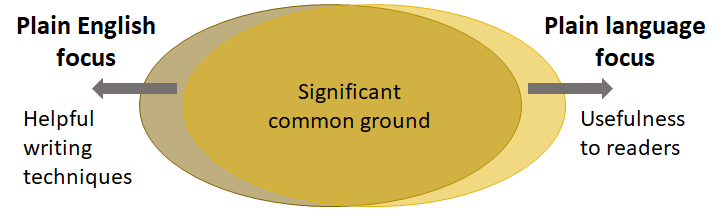
plain language focuses on usefulness

Of course, the overlap between the two groups of professionals is vast. There is more that unites than divides. Plain language writers will use all the plain English techniques, and plain English writers always consider their readers. However, in my view, the gradual shift in focus is real.

The Australian Office of Parliamentary Counsel has said:

We prefer to use the term “plain language” rather than “plain English” because we believe that it covers a wider range of techniques and practices. (http://www.opc.gov.au/PLAIN/index.htm – link no longer active)

Even Wikipedia entries reflect this subtle difference in focus:

Plain English is language that is easy to understand, emphasizes clarity and brevity, and avoids overly complex vocabulary.
(https://en.wikipedia.org/wiki/Plain_English)

Plain language is writing designed to ensure the reader understands as quickly, easily, and completely as possible.
(https://en.wikipedia.org/wiki/Plain_language)

So what? Is this an artificial distinction and ‘splitting hairs’.

I think not. The difference is important, especially when writing functional business documents. Writing clear and concise text is not the goal. Effective communication is the goal – and that requires a deliberate focus on readers and usability. Readers should both understand the content and know what to do with it. Functional documents are not just about informing; they aim to impact the way readers think, feel and act.

How to write in plain language (plain English)

Impress people with your thinking, not your language.

Big words and complex sentences can generate an impression of being ‘educated’. Some writers deliberately make text difficult to understand to create an air of mystique and to emphasise the distance between their intelligence and that of the reader. This pretence gets in the way of communication.

A good writer works hard so that the reader won’t have to.

The writer’s job is to tell as much as possible, accurately and clearly, in as little reading as possible. Make it easy for your reader to receive and understand your ideas.

 1. Prefer clear, familiar words

The reader should never have to guess at a meaning, encounter ambiguity or be forced to interpret an expression. Use words familiar to your audience. Use just enough words to get the message across clearly.

Do not use facilitate when you could use help, utilise when you could write use, endeavour instead of try, or sufficient when you could write enough.

 2. Prefer the active voice over passive voice

Sentences written in the active voice tend to be more direct and easier to follow. They are usually more personal than sentences in the passive voice because they include references to human “agents” (participants doing the action).

In active voice sentences, the ‘agent’ (the participant doing the action) is placed before the verb:

We will send your receipt next week.

(agent) (verb) (thing acted upon) (circumstance)

rather than

Your receipt will be sent next week.

(thing acted upon) (verb) (circumstance)

 3. Use verbs, not nouns made from verbs

One of the best ways to make text easier to understand is to replace abstract nouns (nouns like ‘verification’, ‘identification’, ‘performance’, ‘encouragement’, ‘authorisation’) with the equivalent verb.

Write You must comply rather than Compliance with these regulations is vital.

Write We could explain this by … rather than A possible explanation is that there is …

Write When you renew this policy rather than Upon renewal of this policy

 4. Write short, point first sentences

Long sentences can confuse readers even though they may be grammatically correct. People read all the way to the full stop before pausing to absorb what they have read, so long sentences strain memory.

It’s nearly always better to have the point that you want to make at the beginning of the sentence – that’s where readers start reading!

Write Without further information the draft submission cannot be approved. if you want to emphasise the lack of information.

Write The draft submission cannot be approved without further information. if you want to emphasise rejecting the submission.

 5. Use conversational style as a guide

You are writing to people!

Be wary of deliberately distancing yourself from people by the way you write. Even bureaucratic organisations are designed, maintained and populated by people. They impact people. Address the reader directly whenever possible and especially when you are writing a letter. Use personal pronouns – “you” for the reader and “we” for your organisation. Use “I” if you are specifically referring to yourself.


Why I am a plain language zealot

All business and government documents should be written in plain language. These are ‘functional documents’; people are expected to use these documents (information products) to do something.

Plain language builds a more just society

Writing plainly means more people will be able to read and understand your message.

If our audiences cannot follow legal documents, information leaflets or letters, there is the risk of their breaking the law, or failing to do what is expected of them or receiving what is rightfully theirs.”
(Tasmanian Government)

Choosing not to write plainly can introduce social disadvantage. Excluding people from being able to easily understand contracts, laws and other information limits their choices. They can’t fully participate in society.

Plain language displays clear thinking

“If you can’t explain it simply, you don’t understand it well enough.” (attributed to Albert Einstein) No matter who said it, the idea is helpful.

When you have a deep understanding of an idea, you can find words, metaphors and images that help other people understand it too. You can explain the idea simply and with precision. If you only have a superficial understanding, you are likely to express the idea vaguely. It is unlikely to be written plainly.

If people understand more of what you’re saying, they will likely feel that you make sense.
(Hoa Loranger)

Plain language aids effectiveness and efficiency

Business and government documents need to be both effective (achieve purpose) and efficient (read and understood quickly). Writing in plain language helps achieve both goals.

Complex, technical or pompous writing does not convey ideas quickly – readers have to battle to make sense of what is written. Writing plainly means using words and structures that your audience can quickly understand. (Knowing your audience is vital – when writing for technical readers you may use terms that lay people would call jargon.)

Writing plainly using familiar words and simple structures is not dumbing down. It helps less able readers to understand, and helps more able readers to read faster.

Claiming something is written plainly does not make it so

I came across this sentence recently:

The text provides, in plain English, an overview of what is necessary to give effect to a valid advanced care directive, and through illustrative and contemporary examples, enhances our understanding of the importance of “planning ahead”.

I don’t think many plain language professionals would say this is plainly written, despite the claim. When you have written plainly, you do not need to tell people you have done so – it will be obvious to your readers. They will be engaging with your ideas, not your writing. (reminds me of one of my other guiding principles: Never trust anyone who has to say “Trust me”.)

Some particular problems:

  • ‘to give effect to’: This is an uncommon and somewhat pretentious phrase, likely to put many readers off. Its use is unclear – it has the immediate sense of ‘how to write an advanced care directive’, but the literal meaning is ‘when your advanced care directive becomes operational’.
  • ‘an overview of what is necessary’: Too wordy.
  • ‘enhances our understanding of the importance of’: Too wordy.
  • ‘illustrative and contemporary’: Big words where small ones will do.
  • Many ideas in a sentence that is too long. As a rule of thumb: one point, one sentence.

A possible rewrite:

This booklet explains how to make an advanced care directive. The examples show how planning ahead is very important.

Can you provide a better rewrite? I’ll leave this post open for comments for a while.