Tag Archives: user focus

Social justice when writing

Clear, well-written documents from businesses and government agencies help people understand their rights, responsibilities, and options.

When information is written in plain language, more people can access, understand and act on it. This leads to fairer outcomes and greater participation. Complex, technical, or overly formal writing can exclude many readers — especially those who do not have an academic background or who struggle to read.

We can create or exacerbate social disadvantage just by the way we choose to word things and express ideas. That is a really sad outcome. Choosing not to write plainly can create disadvantage, limit access to essential services, and undermine trust.

Writing clearly isn’t just a communication skill — it’s a matter of equity.

Plain language vs Plain English – a subtle but important difference

When I first started in this industry over three decades ago, I thought the terms ‘plain language’ and ‘plain English’ were synonymous.

Writing professionals from Canada often talked about ‘plain language’ because they dealt with both French and English, but in countries like Australia, New Zealand, USA and Britain the term ‘plain English’ was more common. (By the way, Canada has a long and rich history encouraging plain writing – since the 1920s the Royal Bank of Canada newsletter has provided helpful advice about writing clearly.)

But over the decades I’ve observed a subtle shift; a shift in emphasis or focus.

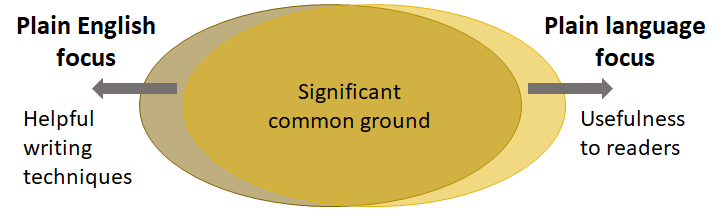
Plain English professionals tend to focus on features of the language. They aim to make documents clear and concise. They talk about helpful techniques like using familiar words, preferring the active voice, writing with more verbs than nouns, keeping sentences short and writing in a conversational style.

Plain language professionals tend to focus more on readers and the way they respond to a document. They aim to make documents clear, concise and effective. They consider how the reader will encounter the document and the desired response. Plain language professionals see documents as information products, and so often incorporate user testing before publishing, just as we would for any other product.

Plain English professionals often concentrate on correctness; plain language professionals focus on usefulness.

plain language focuses on usefulness

Of course, the overlap between the two groups of professionals is vast. There is more that unites than divides. Plain language writers will use all the plain English techniques, and plain English writers always consider their readers. However, in my view, the gradual shift in focus is real.

The Australian Office of Parliamentary Counsel has said:

We prefer to use the term “plain language” rather than “plain English” because we believe that it covers a wider range of techniques and practices. (http://www.opc.gov.au/PLAIN/index.htm – link no longer active)

Even Wikipedia entries reflect this subtle difference in focus:

Plain English is language that is easy to understand, emphasizes clarity and brevity, and avoids overly complex vocabulary.
(https://en.wikipedia.org/wiki/Plain_English)

Plain language is writing designed to ensure the reader understands as quickly, easily, and completely as possible.
(https://en.wikipedia.org/wiki/Plain_language)

So what? Is this an artificial distinction and ‘splitting hairs’.

I think not. The difference is important, especially when writing functional business documents. Writing clear and concise text is not the goal. Effective communication is the goal – and that requires a deliberate focus on readers and usability. Readers should both understand the content and know what to do with it. Functional documents are not just about informing; they aim to impact the way readers think, feel and act.
5 steps for effective document review

You’ve slaved away for weeks on an important document. You’ve researched and talked to people. You’ve worked hard to understand your audience, their needs and how they will use your work. You’ve carefully structured the content into sensible chunks and you’ve used plain language techniques as you’ve crafted the text.

But, will the document work? Will it achieve the goals you had in mind?

It’s time for the document review and test phase. Time to find out what other people think of your work. Or perhaps time to send it ‘upstairs’ for sign-off.

Too often authors simply e-mail the document around to colleagues in the office with a message like “I’ve written this. What do you think?” If they don’t hear anything back they assume it’s all OK. But a review process like this rarely provides confidence that the document will communicate effectively. In fact, such a sloppy document review process could be reckless writing. (Our writer training course can reduce costly review churn.)

All communication products should be tested well before release, just like any other product. (Why don’t we test information products?)

So, when you ask people to review a document focus on assessing how well the document will achieve purpose.

Try these 5 steps:

1. Develop thick skin.

People may suggest improvements to your writing (and, by implication, improvements to your thinking). It’s easy to become defensive about the structure and words you have used. Don’t be. If someone finds your message is unclear then you need to improve it.

2. State your purpose clearly; identify your audience.

People can only provide useful review comments when they know what the document is intending to do, and who it is aimed at. When asking for review, explain who the document is for, and how you would like people to respond to your document. Judge the feedback you receive in the light of your purpose and audience.

3. Identify real users.

Representatives of your target audience are the best people to tell you how well your document will work. Anybody else is guessing (although experienced reviewers usually guess well).

4. Prepare document review questions.

Questions help reviewers engage with the material. For example:

  • Does this document contain information or ideas that are important to you?
  • Can you easily find the information you need?
  • Once you find the information, can you understand it?
  • Does it tell you too much? Does it tell you too little?
  • Is the information correct? Could it be misleading?
  • Does it comply with the law (if relevant) and our internal standards (if they exist)?
  • Do you know what to do now that you have read this?

5. Make feedback easy

Tell people how to get their comments to you. Do you want them to talk to you about the document, email you some ideas, or insert their comments in your text? And tell reviewers when you expect their comments.

You don’t need to act on all the review comments. Exercise judgement – some comments will be helpful, some will not. Use feedback to improve your writing, but don’t be bullied by it. After all, it’s your document, so take ownership of it.

Is a document always the best choice?

Sometimes, a document is not the best way of communicating with your audience.

Face-to-face meetings or telephone conversations or video conferencing may be better.

While letters, emails, and documents serve their purpose, they can create delays between sending and receiving messages, slowing down the exchange of ideas.

However, when you speak directly there is opportunity for immediate feedback, clarification, and a more dynamic discussion. This real-time interaction helps prevent misunderstandings and may foster a stronger connection between parties.

Direct dialogue also allows you to pick up on tone, emotion, and nuance that written words often fail to convey. Body language and vocal inflections add crucial layers of meaning to your message.  

After the conversation, it’s wise to follow up with a written summary of key points and any agreements reached. This makes sure everyone is on the same page and provides a clear reference for future use.

Combining the efficiency of verbal communication with the clarity of written records can lead to more productive and successful outcomes.