Tag Archives: plain language

Draft the content, craft the message

Very few organisations set out to publish documents that are confusing or difficult. Usually ambiguous or obscure documents happen by accident. What goes wrong?

Well, often the job is only partly done. Merely putting content together is rarely enough.

Organisations assign subject matter experts to research carefully, organise the content and conduct peer reviews. But then they publish without serious design thinking.

They miss a vital step: crafting the content into an effective communication piece.

Subject matter experts are usually very bright with a deep knowledge of their subject – their input is essential. However, they cannot help but write from their perspective, using their frame of reference and their language. Many readers need the material translated and put into a form that makes sense to them.

For example, a subject matter expert may write:
“Employees must not facilitate or permit the use of employer communication devices by persons not authorised by the Department, unless urgent business or personal circumstances would reasonably require such use.”,
but it is clearer if a user reads:
“You must not allow the Department’s equipment to be used by unauthorised people, unless there is a urgent need”.

Crafting communication from draft content is more than just getting the words right. It involves serious information design with an eye to the user and what they need to do with the information. It involves rethinking structure, document format and graphics.

It’s best to think of writing a complex document as a two-step process:

  1. draft the content (what you want to say)
  2. craft the message (how it should be said)

Two types of expertise are needed – the content expert and the communication expert.

Action

Next time you write a document, remember to both “draft and craft”. Consider involving a communication expert early.

Social justice when writing

Clear, well-written documents from businesses and government agencies help people understand their rights, responsibilities, and options.

When information is written in plain language, more people can access, understand and act on it. This leads to fairer outcomes and greater participation. Complex, technical, or overly formal writing can exclude many readers — especially those who do not have an academic background or who struggle to read.

We can create or exacerbate social disadvantage just by the way we choose to word things and express ideas. That is a really sad outcome. Choosing not to write plainly can create disadvantage, limit access to essential services, and undermine trust.

Writing clearly isn’t just a communication skill — it’s a matter of equity.

Don’t assume others know all the words you do

If you have completed studies beyond high school, you likely have a broader vocabulary than most people.

You will likely know the meaning of more complex words and also be able to untangle complicated sentence structures. While this can be useful in academic or professional settings, it can work against you when you are writing for a broader audience. You may inadvertently assume your readers are OK with some words and phrases just because you are.

So, consider your audience when writing. Limit your use of uncommon or technical words, and stick to everyday language, the kind you’d find in a newspaper.

Simple, familiar words make your writing easier to understand for everyone.

Business and government documents must be written well because…

Business and government documents often contain important information that places obligations on individuals, such as legal responsibilities, financial commitments, or compliance requirements.

When these documents are not written clearly, there is a real risk that people may misunderstand or only partially understand what is required of them. This confusion can have serious consequences, such as missed deadlines, penalties, or unintended breaches of the law.

Poorly written documents can create unnecessary stress, disadvantage, or even oppress people—especially those with lower literacy levels, those for whom English is a second language, or those in vulnerable situations.

Clear and accessible writing helps everyone understand their rights and responsibilities. It promotes fairness, reduces errors and disputes, and builds trust in institutions.

Plain language is also about honesty

Writing plainly means choosing words and sentence structures your readers can easily read, understand and use – information that is designed with their needs in mind.

But plain language is about more than just simplicity — it’s also about honesty and clarity.

A plain language document must give readers accurate, complete, and useful information. That means being upfront, leaving nothing important out, and avoiding confusing or misleading wording. There is no room for half-truths, vagueness, deliberate ambiguity, or obscured meanings.

Readers should be able to trust what they’re reading and clearly understand what it means. Writing this way shows respect for your audience and helps them make informed decisions.

In all government and business communication, plain language supports transparency, accountability, and better outcomes for everyone.

Plain language vs Plain English – a subtle but important difference

When I first started in this industry over three decades ago, I thought the terms ‘plain language’ and ‘plain English’ were synonymous.

Writing professionals from Canada often talked about ‘plain language’ because they dealt with both French and English, but in countries like Australia, New Zealand, USA and Britain the term ‘plain English’ was more common. (By the way, Canada has a long and rich history encouraging plain writing – since the 1920s the Royal Bank of Canada newsletter has provided helpful advice about writing clearly.)

But over the decades I’ve observed a subtle shift; a shift in emphasis or focus.

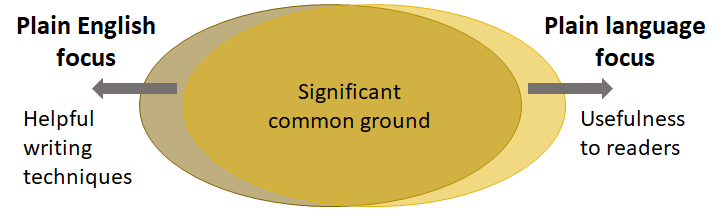
Plain English professionals tend to focus on features of the language. They aim to make documents clear and concise. They talk about helpful techniques like using familiar words, preferring the active voice, writing with more verbs than nouns, keeping sentences short and writing in a conversational style.

Plain language professionals tend to focus more on readers and the way they respond to a document. They aim to make documents clear, concise and effective. They consider how the reader will encounter the document and the desired response. Plain language professionals see documents as information products, and so often incorporate user testing before publishing, just as we would for any other product.

Plain English professionals often concentrate on correctness; plain language professionals focus on usefulness.

plain language focuses on usefulness

Of course, the overlap between the two groups of professionals is vast. There is more that unites than divides. Plain language writers will use all the plain English techniques, and plain English writers always consider their readers. However, in my view, the gradual shift in focus is real.

The Australian Office of Parliamentary Counsel has said:

We prefer to use the term “plain language” rather than “plain English” because we believe that it covers a wider range of techniques and practices. (http://www.opc.gov.au/PLAIN/index.htm – link no longer active)

Even Wikipedia entries reflect this subtle difference in focus:

Plain English is language that is easy to understand, emphasizes clarity and brevity, and avoids overly complex vocabulary.
(https://en.wikipedia.org/wiki/Plain_English)

Plain language is writing designed to ensure the reader understands as quickly, easily, and completely as possible.
(https://en.wikipedia.org/wiki/Plain_language)

So what? Is this an artificial distinction and ‘splitting hairs’.

I think not. The difference is important, especially when writing functional business documents. Writing clear and concise text is not the goal. Effective communication is the goal – and that requires a deliberate focus on readers and usability. Readers should both understand the content and know what to do with it. Functional documents are not just about informing; they aim to impact the way readers think, feel and act.

How to write procedures for business benefit

Most businesses define work activities in a written procedure. (If your business doesn’t, it should.) Procedures, sometimes called Standard Operating Procedures, Work Instructions or Safe Work Method statements, are the basis for a well controlled business.

But how do you write a procedure well? What makes a good SOP?

You could mindlessly follow a template someone else has developed, or you could think about what you want to achieve, what would work best for your business. Some templates can be helpful, but they may not be best for your organisation. See some examples.

The elements of good work procedures

A purpose statement and a link to overall process

Workers need to know how the activity they perform fits into the big picture; how it contributes to the overall process and the purpose of the organisation.You could do this with a context statement, or locating the activity in a process map. Also give a thoughtful title to the procedure.

When working in the road surfacing industry, we changed a procedure title from ‘Drive the broom tractor’ to ‘Prepare the surface’. This had an immediate impact on how workers viewed the activity and lifted the self esteem of the broom driver.

Performance standards

Procedures should do more than merely provide a list of tasks to perform. They should include information about how to assess the quality of those tasks. Workers and supervisors then have some objective measures to judge performance.

The standards could be related to quality, performance or safety.

Grouped into sensible work chunks

Chunking work into steps and sub-steps provides helpful structure for workers. It avoids a long list of tasks, and fits well with the way workers think about the job.

For example, the work chunk ‘Find outstanding invoices’ could have sub-steps like Find the file, Search invoices by date range, Print report.

‘Thinking’ and ‘Doing’ sections

“Work is the exercise of discretion within boundaries.”
John Ralph, former CEO of CRA.

Procedures, SOPs, define the boundaries. They are the things workers must do. But to better engage workers, we want them thinking about their work too. That’s good for them and good for the business. So we might want to direct thinking about productivity, safety or environmental matters.

For example, include thinking prompts in the procedure like: ‘How could we reduce the paperwork?’ ‘Residents may be moving in and out of driveways as you inspect the footpath – take care.’

Standard resources

Include the equipment needed for the task, including safety related equipment. Describe the skills and competencies required. It may be appropriate to include the standard time taken for the task.

All this information allows you to cost the procedure and measure the impact of improvements and changes to business practice. For example, we discovered it takes 10 minutes to process and record payments into a law firm’s trust fund. If the firm offers clients a payment plan, increasing the number of payments, they may significantly increase their back office costs.

Plain language

All documents should be written in plain language.

When procedures are written plainly, workers can understand them quickly and implement them. If they are written in a style that workers find difficult, they may be confused and do the wrong thing, or waste time asking for clarification, or totally ignore the procedures and do what they think is best.

Poor superannuation PDS readability disadvantaging workers

The superannuation industry is in the news again today; described as an “unlucky lottery”. Among other issues, poor information is still a problem – ” They’re bamboozled by poor disclosure …”

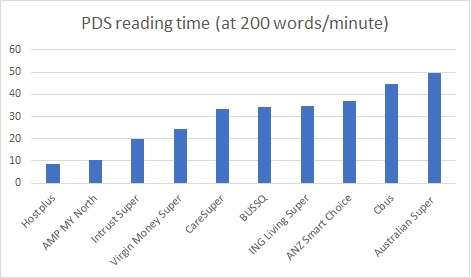
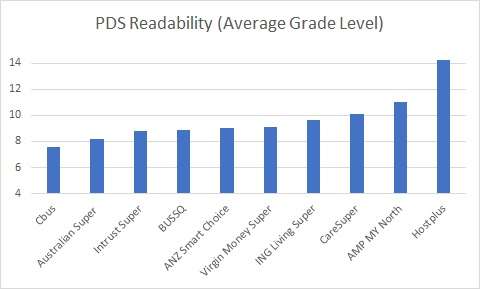
I thought I’d have a look at how easy it is to read some Product Disclosure Documents. I’ve looked at two dimensions across 10 popular superannuation funds.

1. Reading time

People are less likely to read longer documents. We all prefer to read short documents than long ones – we want information fast.

2. Readability

People need easy to read text to help them understand complex ideas. Readability indices are one way to measure how easy it is to read and understand text.

All these indices are higher than the Australian Government’s recommendation of about grade 7 – or maybe a little higher for this type of content.

Why readability matters

The PDS is a functional document. People are supposed to use these to decide whether the fund is a right fit for them. Of course they need to read and understand the information in the PDS to be able to make this decision. And this is an important decision that can have impacts over a lifetime.

Many application forms ask potential members to declare that they have read and understood the PDS. A lengthy or difficult to read document discourages reading. It may encourage people to make a false declaration – to tick the box without reading or understanding.

And difficult to read documents are risky for funds too. The focus is shifting from ‘did you read the document’ (aimed at the reader) to ‘is the document readable’ (aimed at the writer).

Be careful with readability tools

The readability tests I’ve used are mechanical tests that look at word and sentence complexity. They cannot be relied on by themselves, but a high grade index does indicate the text could be simpler. (The grade number refers to US school grade)

These tools do not consider document structure, meaning and the usefulness of content. It is possible to write highly readable rubbish.

The tests in detail

Reading time

I divided the total word count by 200. The average reader reads at about 200 – 220 words per minute.

Readability

I used computerised versions of

  • Flesch Kincaid Grade Level
  • Gunning Fog Score
  • Coleman Liau Index
  • SMOG Index
  • Automated Readability
  • Index Spache Readability Score
  • Dale-Chall Readability Score

and calculated the arithmetic mean.

Documents were sourced on 29 May 2018 from:

Hostplushttps://hostplus.com.au/financial-services-guide
Australian Superhttps://www.australiansuper.com/tools-and-advice/learn/product-disclosure-statements
Intrust Superhttp://www.intrustsuper.com.au/wp-content/uploads/Core-PDS.pdf
CareSuperhttps://www.caresuper.com.au/super/forms-publications/pds
Cbushttps://www.cbussuper.com.au/content/dam/cbus/files/forms-publications/general-information/Cbus-Industry-Super-PDS.pdf
BUSSQhttps://www.bussq.com.au/disclosure
ANZ Smart Choicehttps://www.wealth.anz.com/content/dam/anzwealth/pdfs/superannuation/Smart-Choice-Super-Pension-PDS.pdf
Virgin Money Superhttps://virginmoney.com.au/content/dam/virginmoney/vma-downloads/superannuation/Virgin-Money-Super-Product-Disclosure-Statement.pdf
AMP MY Northhttps://www.amp.com.au/content/dam/product/mynorth/MyNorth_SuperPension_PDS.pdf
ING Living Superhttps://www.ing.com.au/pdf/ING_DIRECT_Living_Super_PDS.pdf

Australian writing skills at an all time low – what’s the impact?

A recent news article states that NAPLAN analysis shows the writing of skills of Australian children are at all time low after what has been described as a 30 year policy failure in schools

https://www.abc.net.au/news/2025-06-26/teaching-resources-reverse-students-poor-writing-naplan/105454122

Where are the children who have been failed for these last 30 years?

They are in the workforce – in mid-career. They are the people who are now writing policy, letters, procedures, briefing notes, reports. If the NAPLAN analysis is correct, then these workers missed some basic education in their formative years in primary school. They did not master the skill of writing at that time. And some may have been struggling ever since.

Of course, school is not the only place where you can learn writing. I’m sure many who attended school during these years are now fine writers. They may have learned writing from good guidance during their tertiary studies, or maybe they’ve learned write well on the job. But it’s possible some of this cohort may still be struggling as they perform the writing tasks required of modern government and business employees.

And I hear senior managers talk about this weakness frequently. They are frustrated about the internal review process – it often takes far longer than it should. And reviewers waste time correcting writing rather than interacting and building on ideas.

Writing is a critical capability.

Failing to develop writing skills is a career disadvantage for individuals. But it also means organisations are also suffering. Ideas may not be expressed clearly; logic and thinking may not be rigorously tested. Information leaflets, letters and other documents do not have the clarity that the users of these products rightly expect.

Writing and thinking are closely connected.

We cannot write well until we can think well. But equally, cannot think well unless we can write well. Writing helps people shape ideas, taking vague and fuzzy notions into concrete words and sentence. Writing makes implicit ideas explicit so that they can be examined and tested by both the writer and by others. Not having a sound writing capability within an organisation puts it at risk of underperforming, of not achieving its objectives as well as it should.

Do you manage people with inadequate writing skills?

Some thoughts if you are in a position of managing people whose writing skills have not yet developed to the level we expect:

  1. Recognise there may have been a gap in learning and development at an early stage. Poor performance may not be related to a lack of intelligence or lack of effort.
  2. Consider enrolling workers in a writer training program. A day of training isn’t going to change the habits of a lifetime immediately. But a well design program will provide direction for participants to practice and follow.
  3. Provide access to helpful tools. Programs like Grammarly and Hemingway can be helpful in getting the basics correct.
  4. Be kind and gentle during the review process. Use document reviews as an opportunity to develop skills. Take the time to explore alternative ways of organising and structuring documents, and explain how to improve sentences and paragraphs.

Developing the writing skills of your people will make documents more effective and efficient.
Writing in plain language is not ‘dumbing down’

I get really annoyed when I hear people use the expression ‘dumbing down’ when they talk about writing documents – especially documents intended for the public. It’s as though they think their readers are idiots. It betrays a level of arrogance that is never helpful when we are communicating with anyone.

Most of the time we are not writing to idiots, but to people of average, maybe even above average, intelligence. They just may not have had all the experiences we have. Writing plainly is about crafting text that is clear and easy to read to help people understand. As Einstein said ‘Everything should be made as simple as possible, but not simpler’. And always write with great respect for your readers.

Why I am a plain language zealot

All business and government documents should be written in plain language. These are ‘functional documents’; people are expected to use these documents (information products) to do something.

Plain language builds a more just society

Writing plainly means more people will be able to read and understand your message.

If our audiences cannot follow legal documents, information leaflets or letters, there is the risk of their breaking the law, or failing to do what is expected of them or receiving what is rightfully theirs.”
(Tasmanian Government)

Choosing not to write plainly can introduce social disadvantage. Excluding people from being able to easily understand contracts, laws and other information limits their choices. They can’t fully participate in society.

Plain language displays clear thinking

“If you can’t explain it simply, you don’t understand it well enough.” (attributed to Albert Einstein) No matter who said it, the idea is helpful.

When you have a deep understanding of an idea, you can find words, metaphors and images that help other people understand it too. You can explain the idea simply and with precision. If you only have a superficial understanding, you are likely to express the idea vaguely. It is unlikely to be written plainly.

If people understand more of what you’re saying, they will likely feel that you make sense.
(Hoa Loranger)

Plain language aids effectiveness and efficiency

Business and government documents need to be both effective (achieve purpose) and efficient (read and understood quickly). Writing in plain language helps achieve both goals.

Complex, technical or pompous writing does not convey ideas quickly – readers have to battle to make sense of what is written. Writing plainly means using words and structures that your audience can quickly understand. (Knowing your audience is vital – when writing for technical readers you may use terms that lay people would call jargon.)

Writing plainly using familiar words and simple structures is not dumbing down. It helps less able readers to understand, and helps more able readers to read faster.

How long is a paragraph?

Paragraphs are flexible. A paragraph can be a single word, or it could be 8 sentences or more if the idea is complex.

A paragraph should contain a single idea. If you have a new idea or a shift in focus, start a new paragraph.

Write the main point in the first sentence. That guides your reader, so they know what to expect. Use the following sentences to expand or explain or illustrate that central point.

Readers are most comfortable when paragraphs average about 4-6 lines. This length provides enough space to develop an idea without overwhelming the reader or creating dense blocks of text.

But it’s also good to have some variety in both sentence and paragraph length to keep your text visually interesting and reduce reader fatigue.

Due diligence in public documents – test before publishing

Due diligence: action that is considered reasonable for people to be expected to take in order to keep themselves or others and their property safe. (Cambridge English Dictionary – my emphasis)

Businesses and government agencies write public documents to inform people about products, services, obligations and opportunities. People may be harmed if they do not fully understand fact sheets, letters, contracts, websites and the like. They may not receive the product or service they expect, they may act in a damaging way, or they miss out on something due to them.

The impact of misunderstanding may be serious or trivial. If the document is about a work process, misunderstanding may result in death or injury. If it is about a financial product, misunderstanding may lead to poverty and disadvantage.

The development process for most public documents is something like

  1. a junior person writes a first draft
  2. a manager reviews and edits the draft
  3. the marketing people provide input
  4. the legal department review, to make sure there is no risk to the organisation
  5. final graphic design and publish.

Organisations may perform these steps with skill and care, but that is not due diligence. It is merely people internal to the organisation talking to each other about the document. They make untested assumptions about how the target audience will understand and react to the document.

Document testing is both reasonable and necessary for public documents

Testing helps keep other people safe. Document testing checks the information can be read, understood and acted on before it is published.

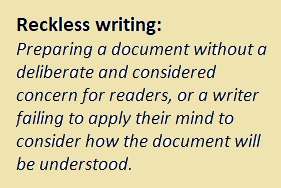
Choosing not to test is reckless.Reckless writing: not caring about readers Simply passing a document around the organisation and throwing it out to the public is not reasonable or responsible. We would never allow a physical product to enter the public arena that way – why do we tolerate it with information products?

Document testing is not difficult, expensive or time consuming. You can find most usability problems by testing with just a handful of potential users.

Claiming something is written plainly does not make it so

I came across this sentence recently:

The text provides, in plain English, an overview of what is necessary to give effect to a valid advanced care directive, and through illustrative and contemporary examples, enhances our understanding of the importance of “planning ahead”.

I don’t think many plain language professionals would say this is plainly written, despite the claim. When you have written plainly, you do not need to tell people you have done so – it will be obvious to your readers. They will be engaging with your ideas, not your writing. (reminds me of one of my other guiding principles: Never trust anyone who has to say “Trust me”.)

Some particular problems:

  • ‘to give effect to’: This is an uncommon and somewhat pretentious phrase, likely to put many readers off. Its use is unclear – it has the immediate sense of ‘how to write an advanced care directive’, but the literal meaning is ‘when your advanced care directive becomes operational’.
  • ‘an overview of what is necessary’: Too wordy.
  • ‘enhances our understanding of the importance of’: Too wordy.
  • ‘illustrative and contemporary’: Big words where small ones will do.
  • Many ideas in a sentence that is too long. As a rule of thumb: one point, one sentence.

A possible rewrite:

This booklet explains how to make an advanced care directive. The examples show how planning ahead is very important.

Can you provide a better rewrite? I’ll leave this post open for comments for a while.

You’ve written it with care, but will it be read, understood and acted on?

User testing is a must to increase the chance that a document is read, understood and acted on. (A document could be a printed process, fact sheet or report, or it could be web text.)

Effective business documents have an impact on the thinking, attitudes or behaviour of readers. If they don’t, the investment in researching, writing and reviewing is all wasted. Writing with care is vital; but care in crafting the document doesn’t guarantee success. Even well organised, plainly written documents can fail to achieve their purpose.

Testing documents with users before they are released is the best way to improve the likelihood of success. And it’s not difficult or expensive.

There are multiple ways to test a document, but one of the simplest is to design a set of questions to be used in a structured interview. Give the test subject the document or website to read. Then, ask them questions exploring what they understand and what they would do next.

You can get helpful insights with just a handful of tests.

Testing with real users, or people who represent real users, is far more powerful than passing the text around the office for your colleagues to review. Only real users have the perspectives and the constraints needed for a valid test.

There is never enough time or money to do it right, but there is always enough time and money to do it again.