Tag Archives: effective documents

Plain language is also about honesty

Writing plainly means choosing words and sentence structures your readers can easily read, understand and use – information that is designed with their needs in mind.

But plain language is about more than just simplicity — it’s also about honesty and clarity.

A plain language document must give readers accurate, complete, and useful information. That means being upfront, leaving nothing important out, and avoiding confusing or misleading wording. There is no room for half-truths, vagueness, deliberate ambiguity, or obscured meanings.

Readers should be able to trust what they’re reading and clearly understand what it means. Writing this way shows respect for your audience and helps them make informed decisions.

In all government and business communication, plain language supports transparency, accountability, and better outcomes for everyone.

How to mitigate document risk: Test with real users

Publishing a document that nobody reads, or that people don’t understand, or that users don’t act on, is a waste.

All the investment in crafting and reviewing will have zero return.

It’s very risky to assume a document will achieve purpose on the sole basis of internal review. Merely passing a document around the office to get your colleagues or boss’s opinion is not enough – it’s best to test with end users.

A document is an information product. Users are the only ones who can tell you if your information product is working.

Test early, test frequently to check your document is hitting the mark with users to get confidence that it will be effective.

Plain language vs Plain English – a subtle but important difference

When I first started in this industry over three decades ago, I thought the terms ‘plain language’ and ‘plain English’ were synonymous.

Writing professionals from Canada often talked about ‘plain language’ because they dealt with both French and English, but in countries like Australia, New Zealand, USA and Britain the term ‘plain English’ was more common. (By the way, Canada has a long and rich history encouraging plain writing – since the 1920s the Royal Bank of Canada newsletter has provided helpful advice about writing clearly.)

But over the decades I’ve observed a subtle shift; a shift in emphasis or focus.

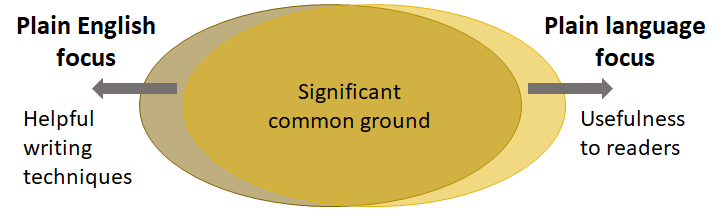
Plain English professionals tend to focus on features of the language. They aim to make documents clear and concise. They talk about helpful techniques like using familiar words, preferring the active voice, writing with more verbs than nouns, keeping sentences short and writing in a conversational style.

Plain language professionals tend to focus more on readers and the way they respond to a document. They aim to make documents clear, concise and effective. They consider how the reader will encounter the document and the desired response. Plain language professionals see documents as information products, and so often incorporate user testing before publishing, just as we would for any other product.

Plain English professionals often concentrate on correctness; plain language professionals focus on usefulness.

plain language focuses on usefulness

Of course, the overlap between the two groups of professionals is vast. There is more that unites than divides. Plain language writers will use all the plain English techniques, and plain English writers always consider their readers. However, in my view, the gradual shift in focus is real.

The Australian Office of Parliamentary Counsel has said:

We prefer to use the term “plain language” rather than “plain English” because we believe that it covers a wider range of techniques and practices. (http://www.opc.gov.au/PLAIN/index.htm – link no longer active)

Even Wikipedia entries reflect this subtle difference in focus:

Plain English is language that is easy to understand, emphasizes clarity and brevity, and avoids overly complex vocabulary.
(https://en.wikipedia.org/wiki/Plain_English)

Plain language is writing designed to ensure the reader understands as quickly, easily, and completely as possible.
(https://en.wikipedia.org/wiki/Plain_language)

So what? Is this an artificial distinction and ‘splitting hairs’.

I think not. The difference is important, especially when writing functional business documents. Writing clear and concise text is not the goal. Effective communication is the goal – and that requires a deliberate focus on readers and usability. Readers should both understand the content and know what to do with it. Functional documents are not just about informing; they aim to impact the way readers think, feel and act.

5 steps for effective document review

You’ve slaved away for weeks on an important document. You’ve researched and talked to people. You’ve worked hard to understand your audience, their needs and how they will use your work. You’ve carefully structured the content into sensible chunks and you’ve used plain language techniques as you’ve crafted the text.

But, will the document work? Will it achieve the goals you had in mind?

It’s time for the document review and test phase. Time to find out what other people think of your work. Or perhaps time to send it ‘upstairs’ for sign-off.

Too often authors simply e-mail the document around to colleagues in the office with a message like “I’ve written this. What do you think?” If they don’t hear anything back they assume it’s all OK. But a review process like this rarely provides confidence that the document will communicate effectively. In fact, such a sloppy document review process could be reckless writing. (Our writer training course can reduce costly review churn.)

All communication products should be tested well before release, just like any other product. (Why don’t we test information products?)

So, when you ask people to review a document focus on assessing how well the document will achieve purpose.

Try these 5 steps:

1. Develop thick skin.

People may suggest improvements to your writing (and, by implication, improvements to your thinking). It’s easy to become defensive about the structure and words you have used. Don’t be. If someone finds your message is unclear then you need to improve it.

2. State your purpose clearly; identify your audience.

People can only provide useful review comments when they know what the document is intending to do, and who it is aimed at. When asking for review, explain who the document is for, and how you would like people to respond to your document. Judge the feedback you receive in the light of your purpose and audience.

3. Identify real users.

Representatives of your target audience are the best people to tell you how well your document will work. Anybody else is guessing (although experienced reviewers usually guess well).

4. Prepare document review questions.

Questions help reviewers engage with the material. For example:

  • Does this document contain information or ideas that are important to you?
  • Can you easily find the information you need?
  • Once you find the information, can you understand it?
  • Does it tell you too much? Does it tell you too little?
  • Is the information correct? Could it be misleading?
  • Does it comply with the law (if relevant) and our internal standards (if they exist)?
  • Do you know what to do now that you have read this?

5. Make feedback easy

Tell people how to get their comments to you. Do you want them to talk to you about the document, email you some ideas, or insert their comments in your text? And tell reviewers when you expect their comments.

You don’t need to act on all the review comments. Exercise judgement – some comments will be helpful, some will not. Use feedback to improve your writing, but don’t be bullied by it. After all, it’s your document, so take ownership of it.

Think before you consult when writing policies

Employee consultation has become a ‘sacred cow’ when writing policies and procedures. There’s a tendency for organisations to involve all possible stakeholders so that everyone can have their say when defining how things work in an organisation. It’s promoted as a way to create an engaged and empowered workforce; an antidote to a command and control culture.

But consultation takes time and can be counter productive. Countless hours can be lost in document reviews and meetings, sometimes with little benefit.

Yet consultation communicates that you and your organisation value people and respect their point of view, knowledge and experience.

So, think before you run every policy through the same consultation process. Discern which documents will benefit from consultation, and who should be involved.

Consider policies in three broad groups:

1. Policies where consultation is pointless

If you are developing policies or procedure to implement a non-negotiable directive from the board, or a piece of legislation, consultation may not be helpful. Just write the document and get on with it. Consultation in this situation may even be harmful – it can raise the expectation of negotiation and input when there is none. You could lose credibility.

2. Policies where input from others is essential

Sometimes subject matter expertise resides in a number of people. You’ll need to consult to find out what is happening, or the best way of doing something. Find the right people and involve them in every stage of drafting and review. You’ll end up with a richer outcome by listening to appropriate stakeholders.

3. Policies where people just want to have their say

There are some policies in an organisation that stir the passions – like the ‘car policy’. People want to be heard but full consultation is not mission critical. When developing policies like this, I often invite comment but don’t run a full consultation process. Of course, if you invite comment you need to consider it – revise the policy or provide other feedback.

(this blog inspired by a conversation with Adam Leonard, General Manager Human Resources, Anglicare)

How to write standard letters

Crafting a letter once and then sending it to multiple customers or members is a smart way to communicate. Standard letters are especially useful in organisations with repetitive processes and a need to send an identical message to many people.

Standard letters reduce costs because the work is done once only and the benefit enjoyed many times. Standard letters also make sure the message is always consistent.

However, just because a letter is ‘standard’ does not mean it is a good piece of communication. Frequently readers misunderstand letters or fail to appreciate their importance.

One common consequence is increased call centre costs. Recipients call to find out what the letter really means.

Tips when writing standard letters

 1. Know your purpose in writing

Having a clear outcome in mind is essential when writing anything. You must know why you are writing and the impact you intend to have.

Before putting pen to paper, you need to be able to complete the sentence: “As a result of reading this letter, I want Mr Smith to …..”. It may be that you want Mr Smith to do something, think something, or feel something.

Defining the purpose of the letter helps you determine the content, the style and tone, and the call to action.

2. Understand your readers

The better you know and understand your readers, the more likely your letter will ‘contact’ them. Understand their situation, their current understanding of the material, their fears and desires.

It’s helpful to write down all the questions your reader is likely to have. You can probably guess some of these questions, but the only way you’ll know for sure is to ask people. User research (users – people who will use your letter) is essential when planning to write.

3. Know the situation

Standard letters are sent in response to some previous action, often by the member or customer, or because some threshold has been reached.

Knowing what has triggered the letter provides the context for writing and reading. It is helpful to explain to the reader why they are receiving this letter. The context may be obvious to you but your reader may not.

4. Write to your least sophisticated reader

Standard letters are read across a range of readability levels and across a range of familiarity with the content. Write so your less able readers will comprehend. Writing this way won’t disadvantage your more able readers; it just makes it easier for everybody.

Use plain language techniques: familiar words, sentences that make just one point, active voice, etc.

Your readers will appreciate being able to understand your message at first glance, and your call centre will benefit from fewer enquiries generated by unclear letters.

5. Be brief, write point first

Most people are busy. They want to read and understand your letter in the shortest time possible.

Put the main point of your letter at the very beginning. Don’t hold people in suspense. Some readers may only read the first line or two, so don’t keep vital information until the end.

Use as few words as possible to get your message across. If your letter is more than one page long, you reduce the likelihood of it being read completely.

6. Use appropriate variable material

Powerful standard letters include content drawn from your underlying data systems. For example, a superannuation fund may include different information for members aged under 65 than for those over 65.

Including specific information gives your reader a letter that is closely tailored to their needs. They don’t need to figure out for themselves what is relevant and what is not.

Including variable content in standard letters reduces the total number of letters to manage and may reduce system complexity.

7. Test, test, test

You will only know if your letter is working by testing it.

While you are crafting the letter, test early drafts with real users. Ask if they are likely to read the letter, ask if they can understand what it says, ask what they would do as a result of reading it. Refine in response to feedback and re-test.

When your letters are in production, measure if they are achieving purpose. Are people doing what you want them to do when they receive your letter?

Australian writing skills at an all time low – what’s the impact?

A recent news article states that NAPLAN analysis shows the writing of skills of Australian children are at all time low after what has been described as a 30 year policy failure in schools

https://www.abc.net.au/news/2025-06-26/teaching-resources-reverse-students-poor-writing-naplan/105454122

Where are the children who have been failed for these last 30 years?

They are in the workforce – in mid-career. They are the people who are now writing policy, letters, procedures, briefing notes, reports. If the NAPLAN analysis is correct, then these workers missed some basic education in their formative years in primary school. They did not master the skill of writing at that time. And some may have been struggling ever since.

Of course, school is not the only place where you can learn writing. I’m sure many who attended school during these years are now fine writers. They may have learned writing from good guidance during their tertiary studies, or maybe they’ve learned write well on the job. But it’s possible some of this cohort may still be struggling as they perform the writing tasks required of modern government and business employees.

And I hear senior managers talk about this weakness frequently. They are frustrated about the internal review process – it often takes far longer than it should. And reviewers waste time correcting writing rather than interacting and building on ideas.

Writing is a critical capability.

Failing to develop writing skills is a career disadvantage for individuals. But it also means organisations are also suffering. Ideas may not be expressed clearly; logic and thinking may not be rigorously tested. Information leaflets, letters and other documents do not have the clarity that the users of these products rightly expect.

Writing and thinking are closely connected.

We cannot write well until we can think well. But equally, cannot think well unless we can write well. Writing helps people shape ideas, taking vague and fuzzy notions into concrete words and sentence. Writing makes implicit ideas explicit so that they can be examined and tested by both the writer and by others. Not having a sound writing capability within an organisation puts it at risk of underperforming, of not achieving its objectives as well as it should.

Do you manage people with inadequate writing skills?

Some thoughts if you are in a position of managing people whose writing skills have not yet developed to the level we expect:

  1. Recognise there may have been a gap in learning and development at an early stage. Poor performance may not be related to a lack of intelligence or lack of effort.
  2. Consider enrolling workers in a writer training program. A day of training isn’t going to change the habits of a lifetime immediately. But a well design program will provide direction for participants to practice and follow.
  3. Provide access to helpful tools. Programs like Grammarly and Hemingway can be helpful in getting the basics correct.
  4. Be kind and gentle during the review process. Use document reviews as an opportunity to develop skills. Take the time to explore alternative ways of organising and structuring documents, and explain how to improve sentences and paragraphs.

Developing the writing skills of your people will make documents more effective and efficient.
Enjoy writing

Take delight in the words you use and the ideas you are communicating. If you don’t enjoy your writing, there is no way your reader will. Find joy in expressing yourself and communicating ideas.

If you work in either business or government, you are usually writing about things that are important and worthwhile, so write with energy and enthusiasm. That doesn’t mean you need to be flamboyant or overly clever, just be engaged as you write.

Have a worthwhile conversation with your readers – one that progresses the objectives of your organisation while meeting your readers’ needs. Your enjoyment will carry through to your readers – readers can sense when writing is flat and forced.